PRISMATIC ORIGIN
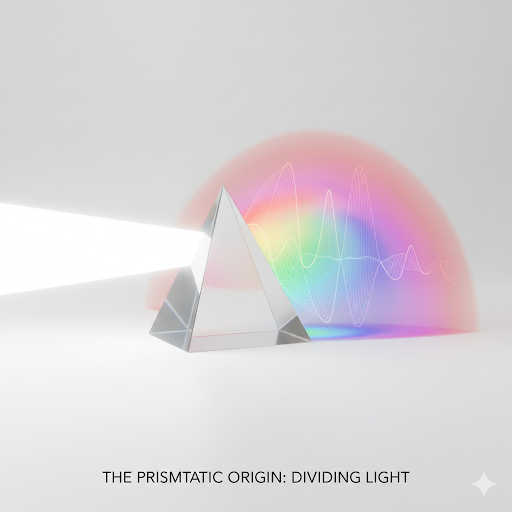
Light exists as white light until, the unseen weaver of the beautiful pattern we perceive as reality, reveals the vibrant complexity hiding underneath the mask of white light. To organize the chaotic threads of light and reveal the hidden secret spectrum of color, we need a prism. This section is a creative exploration into the Prismatic Origins of Color and blending the physics of light with the artistic appreciation of color.


CONTENTS
Introduction
Part I: The White Mask (The Physics of Light)
Concept: White light isn't "colorless"; it is all colors trapped together.
The Hero: The Photon.
Part II: The Breaking Point (Refraction)
The Event: What happens when light hits a prism (or a raindrop).
The Mechanics: Speed changes, bending (refraction), and the separation of wavelengths.
Part III: The Arc (The Rainbow)
Nature’s Prism: How geometry and water create the bow.
The order of the spectrum (ROYGBIV).
Part IV: The Perception (The Human Eye)
How we translate these waving photons into "Red" or "Blue" in our brains.
INTRODUCTION
We tend to think of darkness as the mystery, but the true master of disguise is White Light. To the naked eye, a ray of sunlight looks simple, clear, and empty. But this is a deception. White light is not the absence of color; it is the totality of it. It is a crowded vessel, packed tight with every conceivable hue, all traveling together in a chaotic, invisible harmony. Think of a beam of light as a rope. It looks like a single strand, but it is actually woven from millions of smaller threads—some vibrating slowly (Red), some vibrating violently (Violet). As long as they travel through the vacuum of space or the clear air, they remain tightly wound together, hiding their true nature. To see the secret, you need an obstacle. You need an intervention. You need a Prism.
PART I
THE WHITE MASK: The Physics of Light
"The White Mask" is a perfect metaphor because white light hides the vibrant complexity underneath until something—like a prism or a raindrop—strips that mask away. Here is a breakdown of the physics behind your concept and the "hero" of our story. In physics, we call this Polychromatic Light. White light is essentially a "mosh pit" of every visible wavelength. When they all travel together at the same speed (the speed of light), they overlap so perfectly that our eyes perceive them as a singular, neutral "white."
The Trap: Think of white light as a sealed envelope. You can't see the letters inside until you open it. In physics, we "open" the envelope through refraction.
The Reveal: When white light hits a different medium (like glass or water), each color—having a different wavelength—bends at a slightly different angle. This is how the "mask" is removed to reveal the rainbow (the spectrum).
THE HERO: The Photon
If white light is the mask, the Photon is the actor behind it. The photon is the fundamental particle of light, but it’s a bit of a "weirdo" in the best way possible.
The Dual Identity: As you’ve explored before, the photon isn't just a particle; it’s a wave. This is Wave-Particle Duality. It travels as a wave of electromagnetic energy but interacts with matter as a discrete packet (a "quantum") of energy.
The Energy Carrier: A photon’s "color" is determined by its energy: High-energy photons vibrate fast and have short wavelengths (the Violets and Blues) and Low-energy photons are more relaxed with long wavelengths (the Reds).
The Ageless Traveler: Because photons travel at the speed of light (c), according to Einstein’s Special Relativity, they do not experience time. From a photon's perspective, the moment it is emitted from a star and the moment it hits your eye are the exact same instant—even if that journey took billions of years.
E=hf
In this equation, E is the energy of our hero (the photon), h is Planck's constant, and f is the frequency. It shows that energy and "color" (frequency) are one and the same. To understand how the Photon weaves the White Mask, we have to look at how these tiny messengers interact with the "Spider's Web" of atoms before the signal ever reaches your brain. Let's dive deeper into how these photons interact with the "Spider's Web" of atoms, and then we shall we move on to how the eye interprets this "White Mask". This is a brilliant way to connect them.
THE SPIDER WEB: The Interaction of Atoms
Think of every object in the world as a complex web of atoms. When our hero, the Photon, hits an object, it's like a fly hitting a web. One of three things happens:
Absorption (The Trap): The atom "catches" the photon. The photon’s energy is converted into heat. If a material absorbs all colors, it appears black—the ultimate trap.
Reflection (The Bounce): The photon hits the "web" and bounces off. If all the "colors" in the white mask bounce back at once, we see a white surface.
Transmission (The Passage): The photon passes right through the gaps in the web. This is what happens with glass or clear water.
The "Spider's" Selection: A red apple looks red because its atomic "web" is designed to trap every color except red. It rejects the red photons, bouncing them into your eyes. The "White Mask" is essentially a crowd of photons that haven't been "filtered" by a web yet.
THE INTERPRETATION: How the Eye Sees the Mask
Once those photons bounce off the world, they hit your retina. This is where the physics of the universe meets the biology of your mind.
THE SENSORS
The Sensors (Rods and Cones): Your eyes have specialized cells that act like "photon counters":
Rods: These are your "night vision" sensors. They don't see color; they just see the presence of photons.
Cones: These are the color specialists. Most humans have three types: Red, Green, and Blue.
THE SYNTHESIS
The Synthesis of White: When you look at "White Light," it’s not that your eye sees a "white" wavelength. Instead, the white light hits all three types of cones at the same time with equal intensity.
The Red cones fire.
The Green cones fire.
The Blue cones fire.
Your brain receives these three separate signals and "blurs" them together. "White" is a mental construct—it is your brain’s way of saying, "I am being overwhelmed by all the colors at once!" ---
THE JOURNEY
Summary of the Hero's Journey:
The Photon starts as a high-speed wave with no "time" of its own.
It travels in a pack (The White Mask).
It hits the Atomic Web of an object.
If it survives the "trap," it hits your Cones.
Your brain weaves those signals into the world you see.
Let's take a look at how Photoshop uses this RGB physics to create art and then explore how refraction (like a prism) specifically "unties" the web to show the rainbow.
PHOTOSHOP: The Digital White Mask
In Photoshop, the "White Mask" isn't a physical substance—it’s math. When you work in RGB mode, you are essentially playing the role of the "Spider," choosing which photons to let through and which to block using digital tools. Photoshop uses Additive Color Mixing, which mimics how light works in the physical world. While a painter starts with a white canvas and adds dark pigments (Subtractive), Photoshop starts with a "Black Void" (your monitor turned off) and adds light.
The Trinity (RGB): Photoshop creates every color by mixing three specific "Hero" photons: Red, Green, and Blue.
The Binary Mask: Each pixel in your art is assigned a value from 0 to 255 for each channel. Black (0, 0, 0): The absence of all light. The spider has caught every photon and White (255, 255, 255): The "White Mask." All three light sources are firing at maximum power, "trapping" the individual colors in a single bright glare.
Blending Modes as Physics: Screen: This mode mimics the physics of adding light. It ignores the darks and combines the brightness of two layers, much like overlapping two flashlight beams. Multiply: This mimics the Atomic Web. It acts like a filter, removing light and making things darker, similar to how an object absorbs photons.
PART II
THE EVENT
The event or encounter happens when a pack of photons (White Light) traveling through the air hits a denser medium—like a glass prism or a spherical raindrop—they don't just pass through. They are "attacked" by the change in density.
THE BREAKING POINT: Refraction
The "Breaking Point" is the moment the White Mask is shattered. This is the transition from a single beam of white light into the vibrant, chaotic spectrum of colors: What happens when light hits a prism or a raindrop is the event. Speed changes, blending (refraction), and the separation of wavelengths is the mechanism.
THE MECHANISM
Speed changes is how the mask shatters. It explains the mechanism of refraction and dispersion..
Speed Changes: Light is the fastest thing in the universe, but only in a vacuum. When it hits glass or water, it slows down: Think of it like a crowd of people running on pavement suddenly hitting deep sand. Everyone slows down, and the group begins to stumble and spread out.
Bending (Refraction): As the light slows, it bends. The degree of this bend depends on the Wavelength: Violet Photons (High Energy): These have short, fast wavelengths. They are "hit" harder by the glass and bend the most and Red Photons (Low Energy): These are long and "lazy." They aren't as bothered by the change in speed and bend the least.
The Separation (Dispersion): Because Violet bends sharply and Red bends gently, they exit the prism at different points. The "White Mask" is now physically untied, and the internal colors are revealed in a sequence: R-O-Y-G-B-I-V.
PART III
THE ARC: Rainbow
In Part III, our Hero (the Photon) stops being an individual traveler and joins a massive, coordinated light show. A pack of photons is white light and white light is essentially every visible wavelength traveling together at the same speed (the speed of light). When they all travel together at the same speed (the speed of light), they overlap so perfectly that our eyes perceive them as a singular, neutral "white. When the pack of photons (White Light) traveling through the air hits a denser medium—like a glass prism or a spherical raindrop—they don't just pass through. They are shattered by the change in density. This is the Breaking Point, the transition from a single beam of white light into the vibrant, chaotic spectrum of color, The moment the White Mask shatters it doesn't just break; it organizes the order of the spectrum (ROYGBIV) into the most iconic shape in nature: The Arc.
PRISM: The Geometry of Water
In a rainbow, the "Breaking Point" happens inside millions of tiny liquid spheres. This is why raindrops are nature's prism . Unlike the triangular glass prisms you might use in a lab, nature uses a sphere. This change in geometry is what creates the "bow" rather than a flat line of color. This is the "Spider's Web" in its most magical form—the moment physics forces the "Hero" photons to reveal their true identities.
The Entry (Refraction): As white light enters the spherical raindrop, it slows down and bends. This is the "Breaking Point" we discussed, where the colors begin to separate.
The Mirror (Internal Reflection): The light doesn't just pass through the drop. It hits the back surface of the sphere (drop) and reflects inward, like a mirror.
The Exit (The Final Bend): The light exits the front of the drop, bending again one last time to widen the gap between the colors. Because of the sphere's curvature, the light leaves at a very specific set of angles—roughly 40° to 42° relative to the sunlight coming from behind you.
SPHERE: The Evolution of the Drop
While the "White Mask" of physics likes to assume a perfect sphere for simplicity, real raindrops are much more dynamic. The common "teardrop" shape you see in cartoons only exists when water is clinging to a faucet or a leaf. Once a drop is falling through the air, it’s a battle between Surface Tension (the "spider" trying to pull everything into a tight ball) and Air Resistance (the wind pushing back). The shape of a raindrop depends entirely on its size:
Small Drops (The "Globes"): If a drop is smaller than 1 millimeter, surface tension is the undisputed champion.These are perfectly spherical.
Medium Drops (The "Hamburger Buns"): As they get bigger (2–3 mm) and fall faster, the air pressure underneath pushes the bottom up. They flatten out, becoming oblate spheroids—looking exactly like the top half of a hamburger bun.
Large Drops (The "Parachutes"): If they grow larger than 4.5 mm, the pressure in the center becomes so high that the drop actually gets "punched in" from the bottom. It looks like a jellybean or a parachute for a split second before the "White Mask" finally shatters and it explodes into a dozen smaller, spherical drops.
ARCHITECTURE: Of The Arc
This is why the most beautiful rainbows usually happen during a light, misty rain rather than a heavy, violent downpour.
Small, Spherical Drops: These produce the most symmetric and mathematically perfect rainbows because they act like uniform lenses.
Large, Flattened Drops: These can actually distort or "smear" the colors of the rainbow. Because they aren't perfectly round, the light doesn't reflect at that precise 42° angle everywhere. This can cause the rainbow to look brighter on the sides than at the top, or even create "supernumerary" bows—those extra faint fringes of color you sometimes see inside the main arc.
The Personal Rainbow: Because a rainbow is based on the angle between the sun, the drop, and your eye, not people ever see the same exact same rainbow
Since you've mentioned before that you see patterns in everyday life, you might notice that a "bright base" rainbow is a clue that the rain falling near the horizon is made of those larger, "hamburger-bun" shaped drops!
WHY AN ARC?: The Cone of Light
If you could see a rainbow from an airplane, you would see it is actually a full circle. We only see an "arc" because the ground gets in the way of the bottom half.
The Cone: Imagine a giant cone extending from your eye into the rain. Every raindrop sitting on the edge of that cone is at the perfect 42° angle to send light back to you.
The Symmetry: Since a sphere is perfectly symmetrical, it scatters the light in a circular pattern. Whether the drop is "up," "to the left," or "to the right," as long as it stays on that 42° line, it contributes to the circle.
ROYGBIV: The Order of the Spectrum
The order of the rainbow—Red, Orange, Yellow, Green, Blue, Indigo, Violet—is a direct result of how much energy each photon carries.
Why is Red on top? Even though Violet bends the most inside the drop, the geometry of the reflection causes the Red light to exit the drops at a steeper angle (higher in the sky). When you look up, your eye catches the Red light from higher drops and the Violet light from lower drops.
This completes the journey from the "White Mask" to the "Arc." Since you’ve been working on your personal website and exploring color theory in Photoshop, would you like to see how to use these 40-42 degree physics principles to create a hyper-realistic rainbow effect in your digital art?
PART IV
THE PERCEPTION: The Observer
This brings us to the final, most intimate stage of the journey. The White Mask has traveled across space, shattered inside a Raindrop, and now it reaches its final destination: You. In physics, a rainbow is a smooth, messy gradient of infinite frequencies. But in your brain, it is a structured masterpiece of distinct bands. This isn't just "seeing" it is the translation.
THE OBSERVER: Why You are the Center of the Universe
As we discussed, a rainbow isn't a physical object "out there"—it’s a relationship between the Sun, the water, and you.
The Personal Arc: Because the light only hits your eye at that specific 42° angle, if you move, the rainbow moves with you. You can never "reach" the end of a rainbow because the drops creating your rainbow change as your perspective changes.
The Full Circle: Your brain sees an arc because the ground cuts off the bottom. If you were an eagle or a pilot, your brain would perceive a perfect, glowing 360-degree circle.
THE TRANSLATION: From Photons to Neural Language
The moment the photons hit the back of your eye (the Retina), the language changes from physics (waves) to biology(electricity).
The Sensors (Phototransduction): Your retina is like a high-tech "Spider's Web" covered in millions of photoreceptors. Cones are your color-specialists. You have three types: S (Short/Blue), M (Medium/Green), and L (Long/Red).
The Activation: A photon doesn't "have" a color; it has an energy level. When a "Red" photon hits an L-cone, it triggers a chemical reaction that sends an electrical pulse to your brain.
The Brain's "Mixer": Your brain doesn't just see one color at a time. It looks at the ratio of which cones are firing. If both your Red and Green cones are screaming, your brain "translates" that mix into Yellow.
The Illusion of Bands: A rainbow is actually a continuous smear of light, but because our brains are designed to categorize things, we "see" distinct bands like Red and Orange. Your brain is essentially a "Pattern Recognition" machine that turns a messy spectrum into an organized bow.
PHOTOSHOP LAB: Simulating the "Distorted" Drop
Since you've seen that real raindrops are The Mesh (hamburger buns) rather than spheres, you can simulate this "breaking" of the perfect arc in Photoshop to make your art look more organic.
Step 1: Creating the The Mesh the (hamburger buns)
Instead of using a perfect circle, create a drop shape using the Ellipse Tool.
Go to Filter > Distort > Spherize. Use a positive value to "bloat" the center.
Use Edit > Transform > Warp. Pull the bottom of the drop upward slightly to create that flattened, high-speed "hamburger bun" look.
Step 2: The Chromatic Aberration (The Shattered Mask)
To mimic how a flattened drop "smears" the light differently than a sphere:
Duplicate your drop layer twice. Name them R, G, and B.
Right-click each layer and go to Blending Options:
a. On the R layer, uncheck the G and B channels.
b. On the G layer, uncheck R and B.
c. On the B layer, uncheck R and G.
Set all three layers to Screen blending mode.
Now, slightly nudge the R and B layers in opposite directions. This creates a "rainbow fringe" on the edges of the drop, simulating the physics of Refraction!
This completes your journey through the Physics of Light! You've gone from the "White Mask" to the "Shattered Photon," and finally to the "Observer" who brings it all to life.
Since you've mentioned your interest in Physics and Patterns, would you like me to help you draft a "Color Theory" section for your website that explains these concepts to your visitors?
THE PERCEPTION: The Human Eye
How we translate these waving photons into "Red" or "Blue" in our brains
Would you like to move on to Part IV: The Observer, where we look at why your brain creates the rainbow, or should we look at how to simulate these different "distorted" drop shapes in Photoshop?
The light enters the drop (Refraction),
Hits the back of the drop like a mirror (Reflection)
And exits, bending again to widen the gap between the colors.
This is the "Spider's Web" in its most magical form—the moment physics forces the "Hero" photons to reveal their true identities.
Would you like to explore how we can use Photoshop's "Channels" to manually recreate this "Breaking Point" effect in your digital art?
How does this feel for a start?
Does this tone work for you? We can make it:
More Scientific: Focus more on wavelengths, frequency, and Isaac Newton.
More Artistic/Poetic: Focus more on the feeling of color and the visual experience.
More Abstract: Focus on the philosophy of perception (is the color real, or just in our heads?).
Let me know which direction you want to push it!


RED
Longest
Bends the least
Outer Edge


ORANGE/ YELLOW
Medium-Long
Moderate bending
Middle-Top


GREEN
Medium
Balanced bending
Center


VIOLET
Shortest
Bends the most
Inner Edge
BLUE/ INDIGO
Medium-Short
Sharp bending
Middle-Bottom
COLOR:
Wavelength:
Behavior:
Position: